
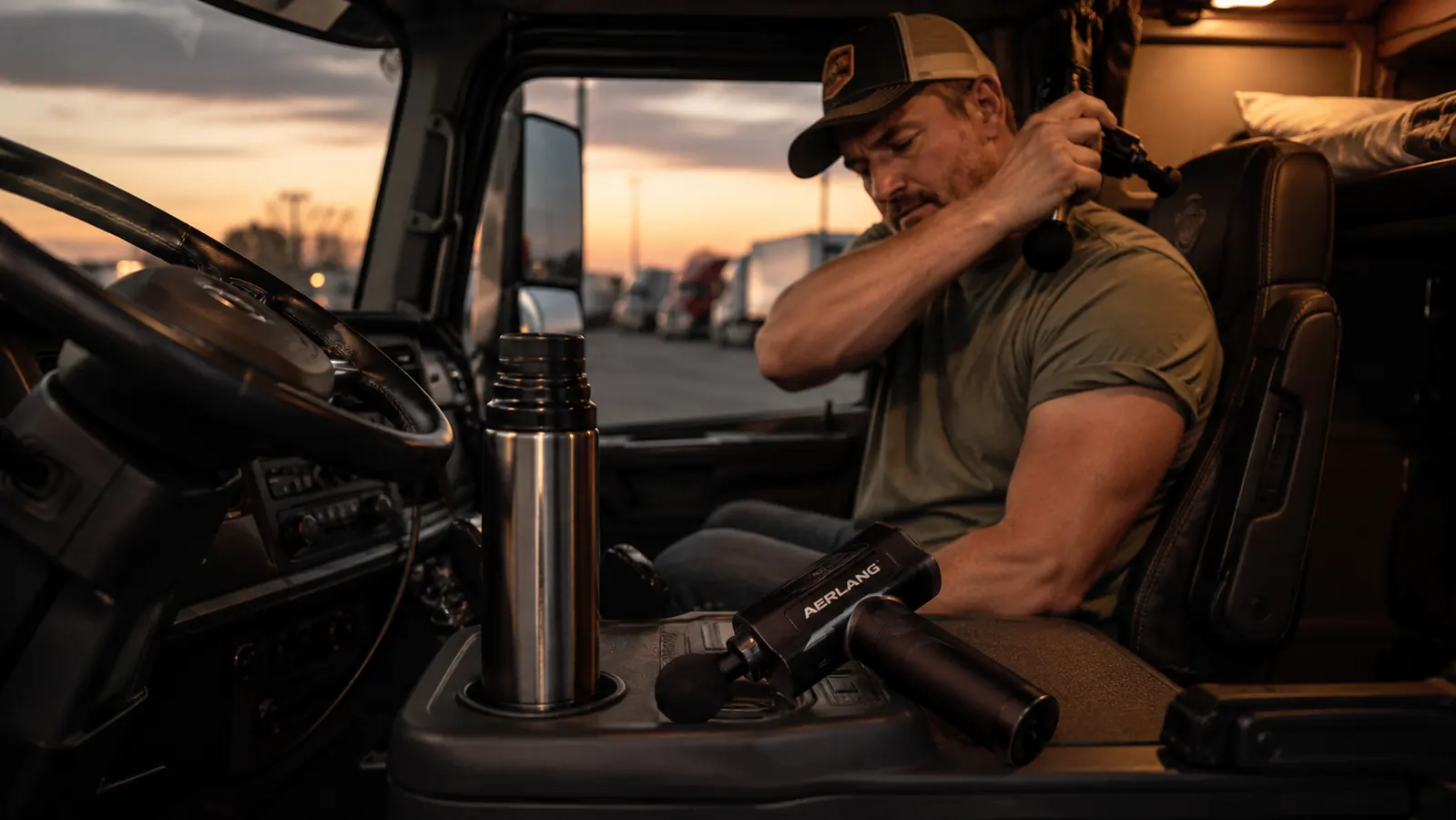
Let me start with the thing the product listing conveniently buries: the heat feature does not heat the entire gun. It heats one specific attachment head, the rounded ball, which you have to swap onto the gun before use. Every other head in the box runs cold. I found that out at 10:30 on a Tuesday night parked at a truck stop outside of Joplin, Missouri, when I pulled the flat head out of the case, clicked it on, and wondered why nothing felt different from my old non-heated gun. That is the kind of detail you only learn from someone who has actually used the thing. This is that review.
The companion review on this site covers the long-term lower-back and hip performance of the AERLANG after six weeks of consistent use. This one covers the stuff nobody talks about: whether the heat actually does anything useful, how long the battery really lasts at the speed settings you will actually use, how loud it gets in a quiet sleeper berth, the quality of the attachments, and honestly, whether a cheaper non-heated gun would serve most drivers just as well. I ran the AERLANG through four weeks of daily sessions before writing a word.
The Quick Verdict
The AERLANG is a solid budget percussion gun that happens to have one heated attachment. That heat head is genuinely useful for stubborn lower-back tightness when you use it correctly. The noise at high speed is too much for a quiet berth, battery life shrinks fast at speeds 3 and above, and two of the six heads feel cheap. For drivers who want heat plus percussion in one unit at a budget price, it delivers. For everyone else, a basic percussion gun gets you 80 percent of the same result for less money.
Amazon Check Today's Price →Still deciding? Check the current price and see how it compares to what you have been tolerating every night.
The AERLANG has over 21,000 reviews on Amazon. Current price and in-stock status are on the product page.
Amazon Check Today's Price on Amazon →The Heat Feature: What It Actually Is and Is Not
The AERLANG uses a thermally enhanced ball head, a rounded attachment with a small internal heating element that reaches around 109 degrees Fahrenheit at its hottest setting. That temperature is warm enough to feel like a heating pad pressed against your lumber, not hot enough to burn. When it is working correctly, the combination of heat loosening the surface tissue and percussion loosening the deeper muscle fiber is noticeably different from percussion alone, particularly on the paraspinal muscles that run along either side of the spine.
The honest limitation is warmth loss over time. After about 12 minutes of continuous use the head temperature drops measurably because the motor heat bleeds off faster than the element can keep up at low percussion settings. At medium percussion (speed 3), the vibration seems to help maintain temperature better, probably because the motor is running warmer. At high speed (5), the battery drain outpaces the thermal benefit and you end up with a gun that is loud, draining fast, and only slightly warmer than a regular head. My practical takeaway: use the heat head at speed 2 or 3 for lower back and lumbar sessions of 10 to 12 minutes. That is the window where heat and percussion actually work together. Beyond that window you are mostly just getting percussion.
For hip flexors and the IT band, the heat head is less useful because those muscle groups respond better to deeper percussion pressure than surface warmth. I switch to the fork head for hip work and the flat head for the upper glutes. Neither of those two gets warm, which is fine. The heat feature is specifically a lower-back tool. If your pain is mostly hip and glute, a non-heated gun gets you to the same place.
Real Battery Life vs What the Box Claims
The packaging says up to six hours. That is true only at speed 1, which is so gentle it barely qualifies as a massage. At speed 1 the percussion depth is about 6mm, which is light enough that you feel more vibration than actual tissue work. Most truck drivers and warehouse workers I know run at speed 3 or 4 for actual muscle relief. At speed 3, I got roughly three hours of actual use before the battery indicator dropped to one bar. At speed 4 or 5 on the heat head, I was down to two hours or less.
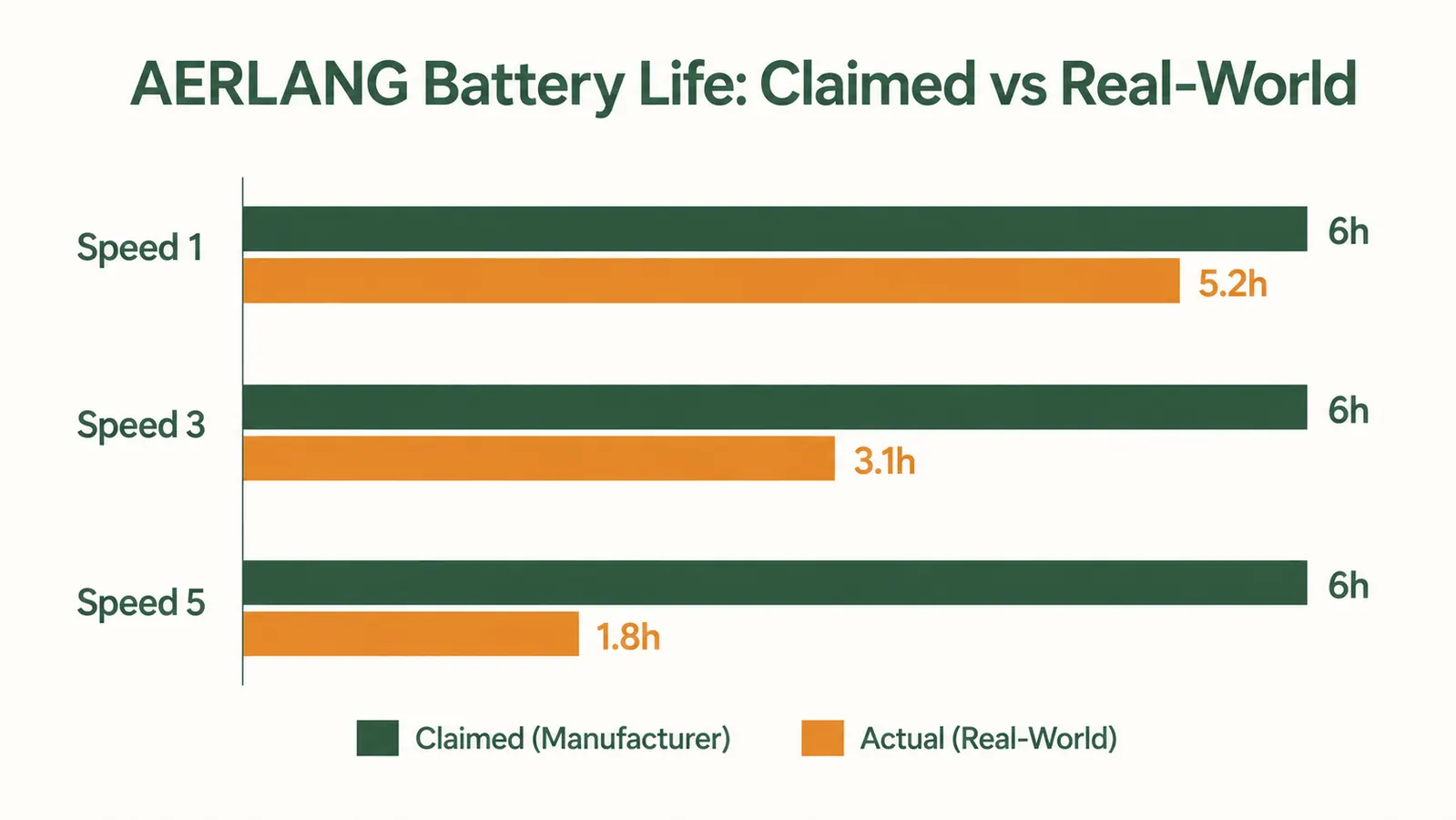
In practical terms: one full charge gets me three to four night sessions at the settings I actually use. For a driver who does a 10-minute session after each shift, that is three to four days between charges. The USB-C charging cable is a genuine win since every modern cab already has a USB-C port. Full charge from empty takes about two hours. I have been leaving it on the center console charging during a run and it has been ready every time I need it. That routine works. If you expect to go a full week without charging, you will be disappointed.
How Loud Is It in a Quiet Sleeper Berth
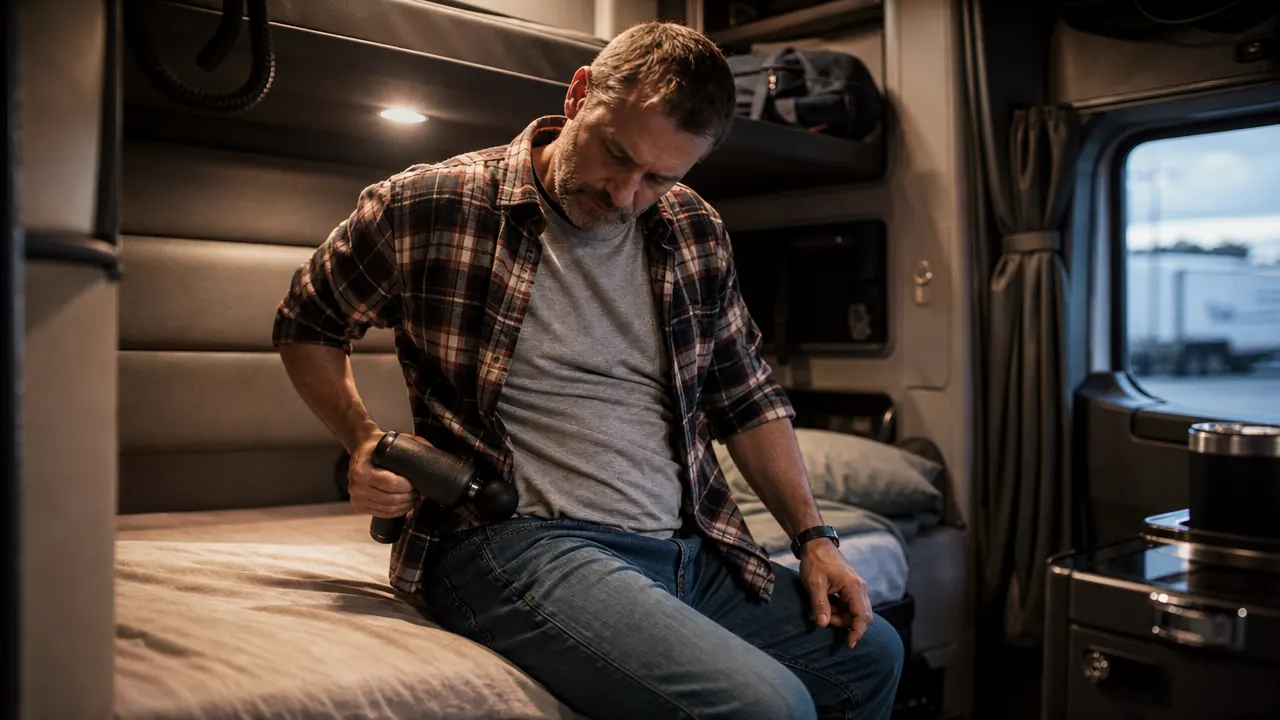
This is the question I wish someone had answered before I bought it. At speed 1 and 2, the AERLANG is genuinely quiet, a low hum that would not wake a partner sleeping two feet away. At speed 3 it steps up to a noticeable motor whine, comparable to a box fan on medium. At speed 4 and 5 it gets loud enough that I would not run it in a shared berth after 10 p.m. without headphones on or music going. The noise is not the percussive thudding sound you hear from cheap guns. It is an electric motor whine that cuts through silence.
My actual practice: I use speed 2 and 3 in the berth at night and save speed 4 for late afternoon sessions when there is ambient road noise covering the motor. If you are a solo driver and nobody else is in the cab, the noise is a non-issue. If you co-drive or share a sleeper, you will want to stick to speed 2 for nighttime use and keep sessions to muscle groups that respond to lighter percussion. For lumbar work at night, speed 2 with the heat head is the combination I settled on.
Speed 2 with the heat head, 10 minutes, lower lumbar area before sleep. That is the routine I landed on after four weeks. If I had known that on day one I would have saved a lot of dead-battery frustration.
Attachment Head Quality: The Honest Assessment
The AERLANG ships with six heads: the heated ball (standout feature), a standard round ball, a flat disk, a fork (U-shaped, good for spine-adjacent work and the Achilles), a bullet/cone, and a wedge. Of those six, three are genuinely useful for seated-worker recovery and two feel like filler.
The heated ball and standard ball cover 80 percent of lower-back and lumbar use cases. The fork head is the most underrated piece in the box. Running the fork along either side of the thoracic spine while seated is more effective for post-drive stiffness than anything else in the kit. The flat head is decent for quads and calves after a long stand-up unloading shift. The bullet and the wedge I have not found a use case for in four weeks. The bullet is too narrow to create meaningful percussion coverage on large back muscles, and the wedge feels imprecise. Both are light enough that they rattle slightly in the case if you do not pack them carefully.
The attachment mechanism itself is a push-click fit with a small rubber collar. It works reliably, but the collar shows scuffs and minor wear after a month. It does not loosen or wobble during use, just looks worn. The handle is rubberized and has stayed grippy even with sweaty hands after loading dock work.
When You Should Skip This Gun and Buy the Cheaper Model Instead
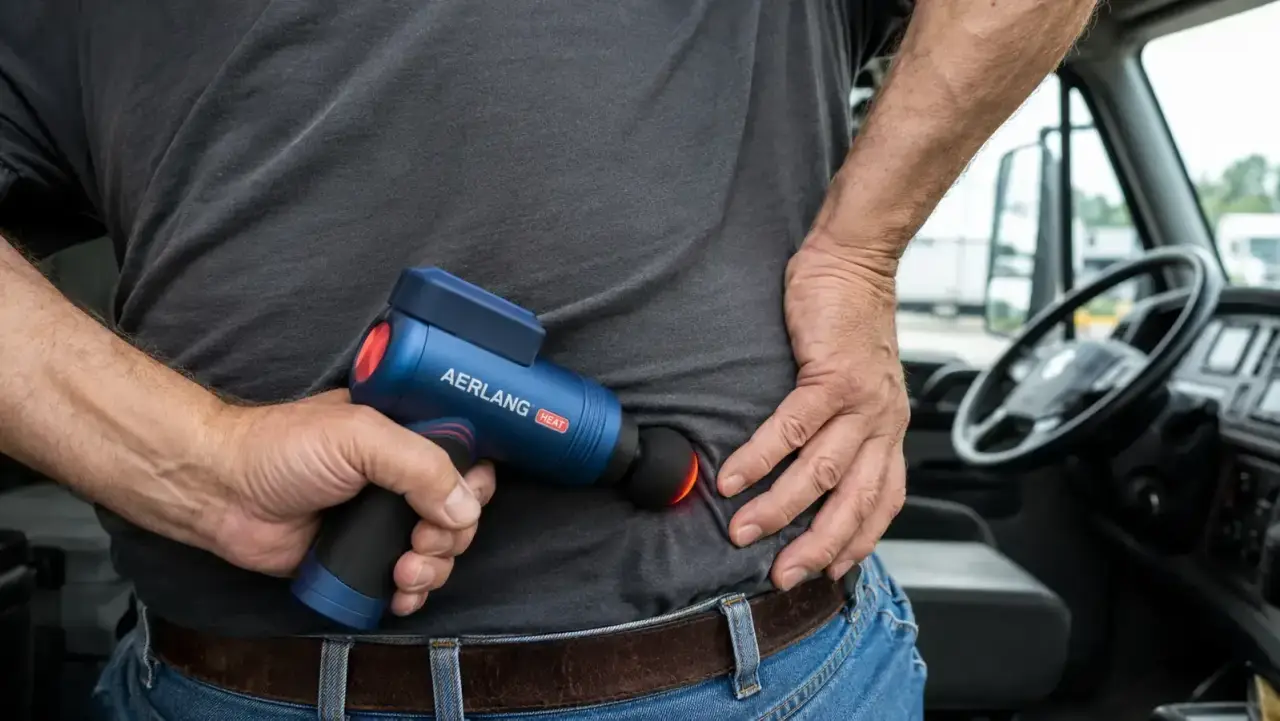
I want to be straight with you on this because I think a lot of review sites skip it: if your pain is primarily hip flexors, IT band tightness, or glute soreness from standing shifts, the heat feature does almost nothing for you. Those muscles sit too deep and too far from the surface for a mildly warm attachment head to make a difference. A basic percussion gun at a lower price point gets you the same depth of relief on those muscle groups. The heat attachment earns its keep specifically on the lower lumbar paraspinal muscles, the long flat muscles that run alongside the lower spine, where the combination of surface warmth and percussion loosens things in a way that percussion alone does not fully replicate.
If you mainly use a massage gun on your shoulders, neck, calves, and feet, and your lower back is not your primary trouble spot, save the money and pick up a basic percussion gun. There are reliable options in the fifteen to twenty-five dollar range that hit the same percussion depth with similar battery life. The heat feature is genuinely useful, but only for a specific use case on a specific muscle group. I do not want someone spending money on a feature they will never actually use.
For the driver or warehouse worker whose main complaint is lower-back tightness and lumbar stiffness after long seated hours, the heat head pays for itself in the first week. That is the buyer this gun was designed for. If that is you, it is the right call. You can read a deeper breakdown of the head-to-head tradeoffs on the heated vs standard massage gun comparison page linked below.
What I Liked
- Heat head genuinely helps stubborn lower-lumbar tightness when used at speed 2-3
- USB-C charging works off standard cab ports, no wall outlet needed
- Quiet enough at speed 1 and 2 for late-night berth use
- Fork attachment is excellent for spine-adjacent paraspinal work
- Over 21,000 reviews with a 4.4 rating gives real confidence it is not a one-batch fluke
- Compact enough to fit in a standard cab door pocket or glove box
Where It Falls Short
- Heat only works on one attachment head, not the whole gun
- Battery drops to roughly 3 hours at speed 3 and under 2 hours at higher speeds with heat active
- Noticeably loud at speed 4 and 5, not sleeper-berth friendly at night
- Bullet and wedge heads feel like filler, limited real-world use
- Heat temperature drops after 12 minutes of continuous use at low percussion settings
- Attachment collar shows wear after a month, cosmetic but worth noting
Who This Gun Is For
The AERLANG is built for the driver or seated worker whose primary complaint is lower-back and lumbar tightness. If you roll out of the cab at the end of a shift with a locked-up lower back, and you want both heat and percussion in a single compact unit that charges off a USB-C port, this is a well-matched tool. It rewards a consistent 10-minute routine, not occasional heavy use. The sweet spot is nightly maintenance sessions at speed 2 or 3 with the heat head on the lumbar and the fork head on the paraspinal muscles.
Who Should Skip It
Skip this gun if: your pain is primarily in the hips, glutes, and IT band rather than the lower back; you need a gun that runs quietly at high percussion speed for late-night berth use; or you want a long single-charge battery life for extended sessions at medium-to-high intensity. Also skip it if you already have a reliable percussion gun that does not have heat, and your lower back is not your main trouble spot. Adding heat to your routine is a meaningful upgrade only if the lower lumbar is where you live with your pain. For a deeper comparison of what the AERLANG does differently over months of regular use, check the long-term lower-back and hip review linked below.
If lower-back tightness is your main problem after a long drive, the heat head on this gun earns its keep fast.
The AERLANG is consistently budget-friendly. Current availability and any price changes are on the Amazon page.
Amazon Check Today's Price on Amazon →