
Here is the short answer: if you sit all day and your ankles and feet swell, you want compression socks, not sleeves. The sock covers your foot and ankle, which is exactly where fluid pools when gravity and a static position team up against you for ten hours. I learned this the slow way, spending money on calf sleeves first because they were cheaper and easier to get on. My calves felt fine. My ankles still looked like stuffed sausages by the time I pulled into the yard.
That said, sleeves have a real use case. If your issue is calf tightness, muscle fatigue during movement, or you need to wear them with your own specialty footwear, sleeves are the better tool. The problem is most drivers default to sleeves without understanding the difference. This comparison lays it out head to head so you can make the right call before spending money on the wrong gear.
| Feature | Copper Compression Socks (Left) | Calf Compression Sleeves (Right) |
|---|---|---|
| Coverage | Full foot, ankle, and calf up to below the knee | Calf only, open toe and open heel |
| Foot and ankle swelling control | Strong. Graduated compression starts at the arch and foot | Weak. Does not compress the ankle or foot at all |
| Calf fatigue relief | Good. Graduated pressure supports the full calf muscle | Good to excellent. Targeted calf compression with full range |
| Best for | Long-haul sitting, edema risk, nurses, varicose vein prevention | Runners, cyclists, post-workout calf recovery, standing-heavy jobs |
| Ease of getting on | Moderate. Must roll on properly from toe to calf, takes 60 seconds | Easy. Slides over calf without threading a foot through |
| Footwear compatibility | Replaces your regular sock, works with any closed-toe shoe or boot | Worn over or instead of a regular sock, works with sandals and open shoes |
| Durability after washing | Good. 6-pair set means rotation extends each pair's lifespan | Fair to good. Single-tube construction holds shape longer per piece |
| Typical mmHg pressure | 15-20 mmHg (moderate, appropriate for daily occupational use) | 15-20 mmHg (same range but applied only from ankle up to knee) |
| Downside | Can feel warm in summer. Takes practice to put on correctly at 5am | Leaves ankle and foot unprotected. Wrong tool for sitting-related edema |
Where Compression Socks Win for Drivers and Seated Workers
When you sit still for hours, blood and fluid follow gravity. The lowest points of your body, your feet and ankles, take the hit. Compression socks address this directly because the graduated pressure starts at the arch of your foot. That is where a calf sleeve cannot reach. The sock squeezes fluid back upward before it has a chance to pool at the ankle. By end of shift, the difference between wearing socks and not wearing anything is visible. After a few weeks of consistent use the difference between socks and sleeves also becomes obvious if you have ever tried both.
The Copper Compression 6-pair set earns its spot here for a practical reason beyond the compression mechanics. Driving shifts mean you are in the same pair all day, often in a warm cab. Having six pairs means you run a proper wash rotation without any pair taking more than two or three wears before it goes through the laundry. The copper-infused fabric cuts down on the smell issue that plagues cheaper socks worn in boots all day. With 47,963 reviews averaging 4.5 stars, a lot of other nurses and drivers have landed on the same conclusion I did.
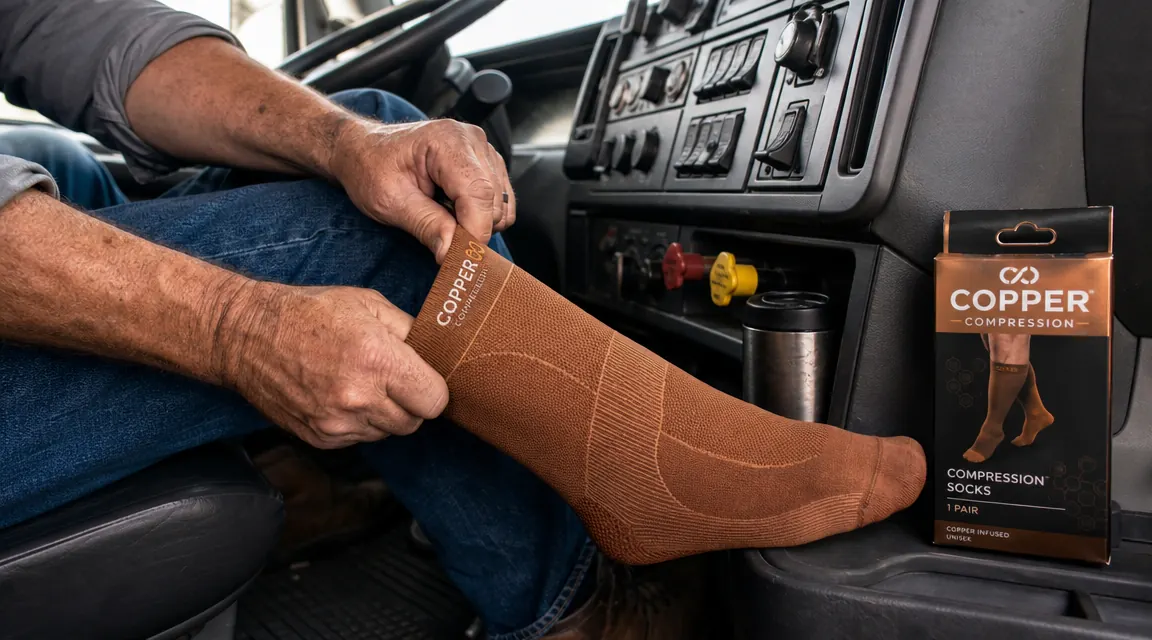
The fit matters more than most people realize. A compression sock that fits correctly feels like a firm, even hug from toe to just below the knee. If it feels like a tourniquet at the top band, the size is wrong. These run true for most people if you follow the calf circumference chart rather than just shoe size. I went with the large based on calf measurement and they hit just right on both legs without bunching at the ankle.
Your ankles should not be swollen by end of shift. Copper Compression Socks cover the full foot and ankle, where sitting-related fluid actually pools.
Copper Compression Socks, 6 pairs. Rated 4.5 stars across nearly 48,000 reviews from nurses, drivers, and anyone putting in long hours on their feet or in their seat.
Amazon Check Today's Price on Amazon →Where Compression Sleeves Win
Sleeves are not a bad product. They are the wrong product for the wrong problem. Where they actually work is calf muscle recovery after physical activity. If you do morning runs before a shift, if you stand and load all day rather than sitting, or if you have a calf-cramp issue without real ankle swelling, a sleeve gives you direct targeted pressure on the gastrocnemius and soleus without tying up your footwear choices. Warehouse workers who are on their feet all day moving product sometimes prefer sleeves because they can wear their own safety boots with thick wool socks underneath and still get some calf support.
Sleeves are also easier to put on when you are groggy at 4am in a rest stop parking lot. There is no threading a foot through and rolling up carefully. You just pull it over the calf and go. If that three-minute sock application feels like too much friction to build the daily habit, a sleeve you will actually wear is better than a sock sitting in your bag. But understand what you are giving up: zero protection for the ankle and foot. For long-haul sitting, that is a significant tradeoff.
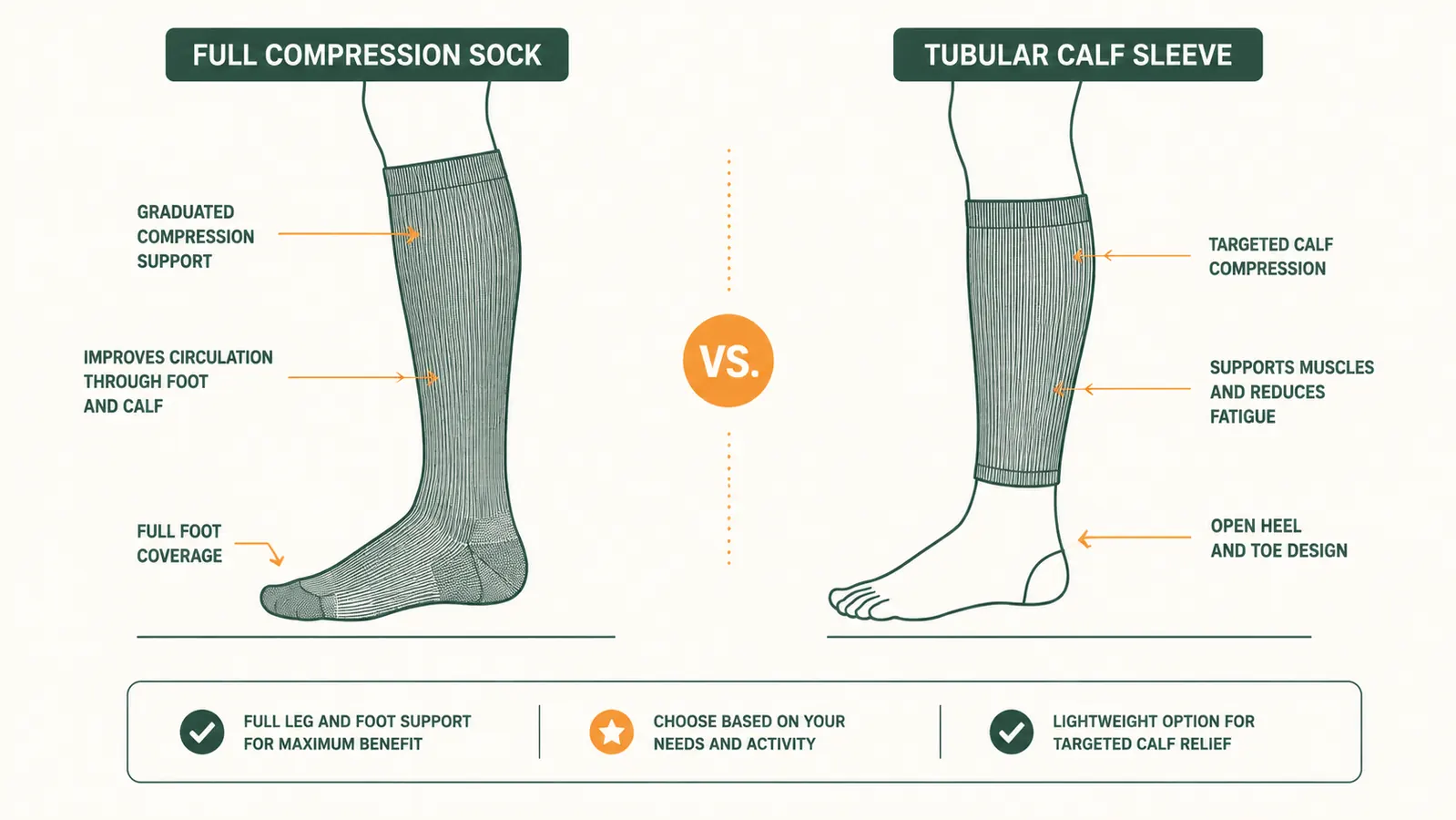
I ran calf sleeves for three months and my calves felt fine. My ankles still looked like water balloons at end of shift. Switched to full socks and the swelling dropped by half the first week.
The mmHg Question: Does the Pressure Level Matter More Than the Type?
Both socks and sleeves come in similar pressure ranges, typically 15-20 mmHg for everyday occupational use and 20-30 mmHg for medical-grade compression. The 15-20 mmHg range is the sweet spot for most drivers and nurses without diagnosed circulatory conditions. It is firm enough to make a difference on swelling and fatigue without being uncomfortable during a full shift or cutting off circulation if you fall asleep with them on.
The Copper Compression socks sit in the 15-20 mmHg range. That is intentional. Over-the-counter compression above 20 mmHg starts to feel medically tight and some people find it irritating under long shift conditions. If you have been diagnosed with lymphedema, deep vein thrombosis, or severe peripheral edema, ask your doctor about prescription-grade 20-30 mmHg socks. For the typical driver or nurse dealing with end-of-day leg tiredness and puffiness, 15-20 mmHg is where you want to be.
Durability and the Wash Rotation Problem
Compression socks lose elasticity faster than regular socks because the compressive fibers are doing constant work. A single pair worn every day and washed every night will start to lose meaningful compression in two to three months. The six-pair set solves this. You wear a different pair each day, each pair gets laundered once a week, and the elastic lifespan stretches to a year or better under normal use. Wash them inside out in cold water on a gentle cycle and skip the dryer. Heat kills elastic fiber.
Calf sleeves tend to hold their shape a bit longer per piece because the simpler tubular construction uses less stretch across a smaller area. But you still need at least two or three pairs in rotation to avoid running a single sleeve into the ground. If you are comparing a single sleeve to a six-pair sock set, the sock set wins on total ownership cost over a year even if the upfront number looks similar.

Who Should Buy Which
Buy compression socks, specifically a full-coverage pair like the Copper Compression 6-pack, if your job involves long hours of sitting behind a wheel, at a desk, or in any position where your feet and ankles are below your heart for most of the day. This includes long-haul and OTR truck drivers, rideshare and delivery drivers, nurses and healthcare workers who are on-and-off their feet, machine operators, and office workers logging marathon days in a chair. If your ankles swell, your feet ache in your shoes, or you get restless heavy legs by evening, socks are the right call.
Choose compression sleeves if your primary complaint is calf muscle fatigue or cramps rather than ankle swelling, if you need to wear them with specialized footwear like steel-toe boots or orthopedic shoes that do not accommodate a thick sock, or if you are doing physical training before or after your shift and want dedicated calf muscle support during activity. Sleeves are also useful as a secondary piece to wear on days off when you want some recovery benefit without a full compression sock.
Six pairs covers your whole workweek with room for wash rotation. That is the reason the full set beats buying a single pair.
Copper Compression Socks for Women and Men, 6 Pairs. 4.5 stars, nearly 48,000 ratings. Graduated compression from arch to calf. Machine washable.
Amazon Check Today's Price on Amazon →