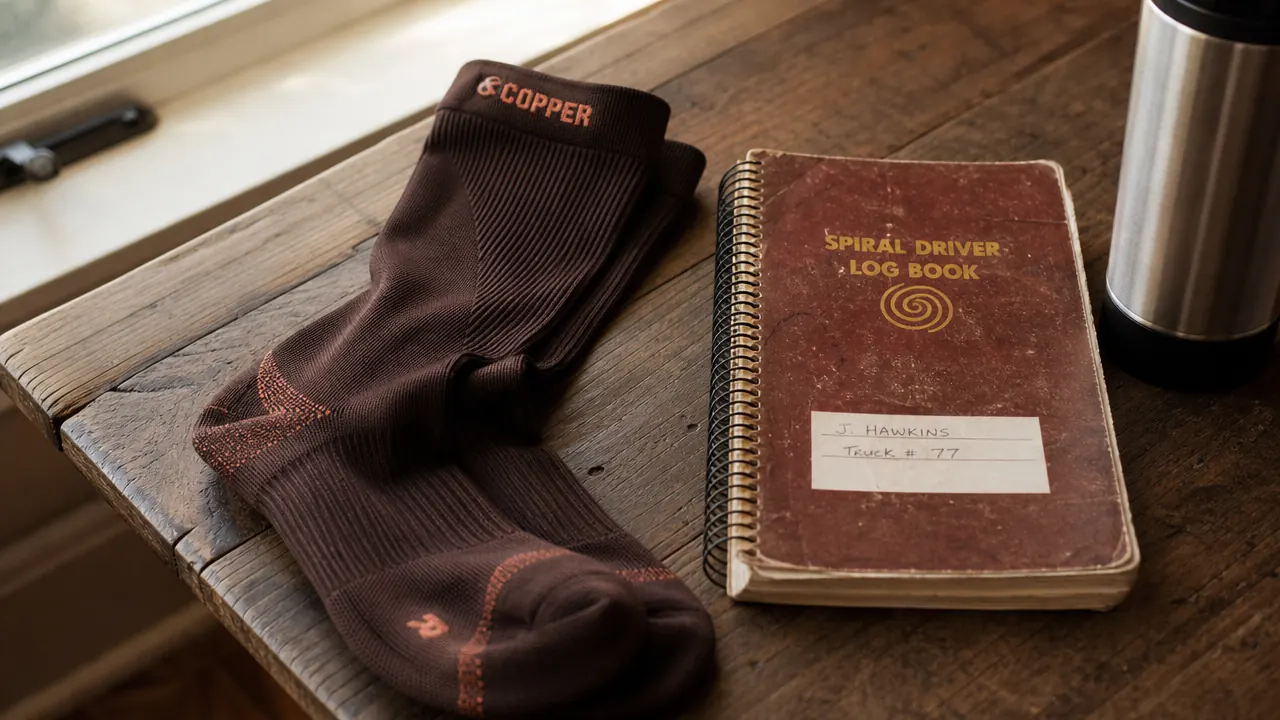
Let me tell you what I noticed the second I read the product listing for these socks. The word "copper" is in the brand name, it's in the headline, and it's all over the bullet points. What's not in the bullet points is an honest answer to the question you should actually be asking: what does the copper do, exactly, and if I strip it out, am I just buying a regular compression sock? I bought six pairs of these Copper Compression socks to find out. I've been driving a flatbed for eleven years, my ankles swell like tree stumps by hour seven, and I've tried more recovery socks than I care to count. This is what I found.
This is not the same review as the long-term nursing shift breakdown we published separately. That one covers what consistent daily wear looks like across months of twelve-hour hospital floors. This one is for the person sitting in their cab right now, staring at that Amazon listing and wondering whether the marketing matches reality. I'm going to walk through the five things the product page won't tell you plainly, in the order that actually matters if you're a driver, a nurse, or anyone whose legs pay the price for a long shift.
The Quick Verdict
Solid 15-20 mmHg graduated compression at a six-pair price that's hard to argue with. The copper is mostly branding, but the compression itself genuinely works for seated-worker swelling and fatigue. Tight on thick calves, and the elastic cuff bands soften faster than you'd like after repeated washing.
Amazon Check Today's Price →Your ankles are not supposed to look like that after a shift.
These are the socks nearly 48,000 buyers reach for first. Six pairs at a price that makes daily rotation through the wash actually practical.
Amazon Check Today's Price on Amazon →What I Tested and How
I ran three consecutive weeks of daily wear across my usual flatbed routes, mostly interstate runs between five and ten hours behind the wheel with limited stops. I wore a pair on shift every day and tracked ankle circumference each morning before putting them on and again at the end of the shift. On alternating weeks I went bare-legs to create a comparison baseline. I also ran all six pairs through my home washer on cold/delicate for 30 straight wash cycles to simulate roughly six months of realistic rotation use on compression fabric, then compared compression snugness against a fresh unopened pair.
My calves measure about 16.5 inches at the widest point, which puts me right at the upper edge of the standard Medium/Large size range. I kept notes on three things: how much ankle swelling I saw at end of shift compared to bare-legs days, how the fabric felt through the day particularly once cab temps climbed, and whether the compression band stayed snug or started to creep down by mile four hundred. I'm not a medical tester and I'm not reporting clinical data. I'm a working driver who bought these with my own money because my legs hurt after long hauls and I wanted to know if they were worth keeping.
The Truth About the Copper Claims
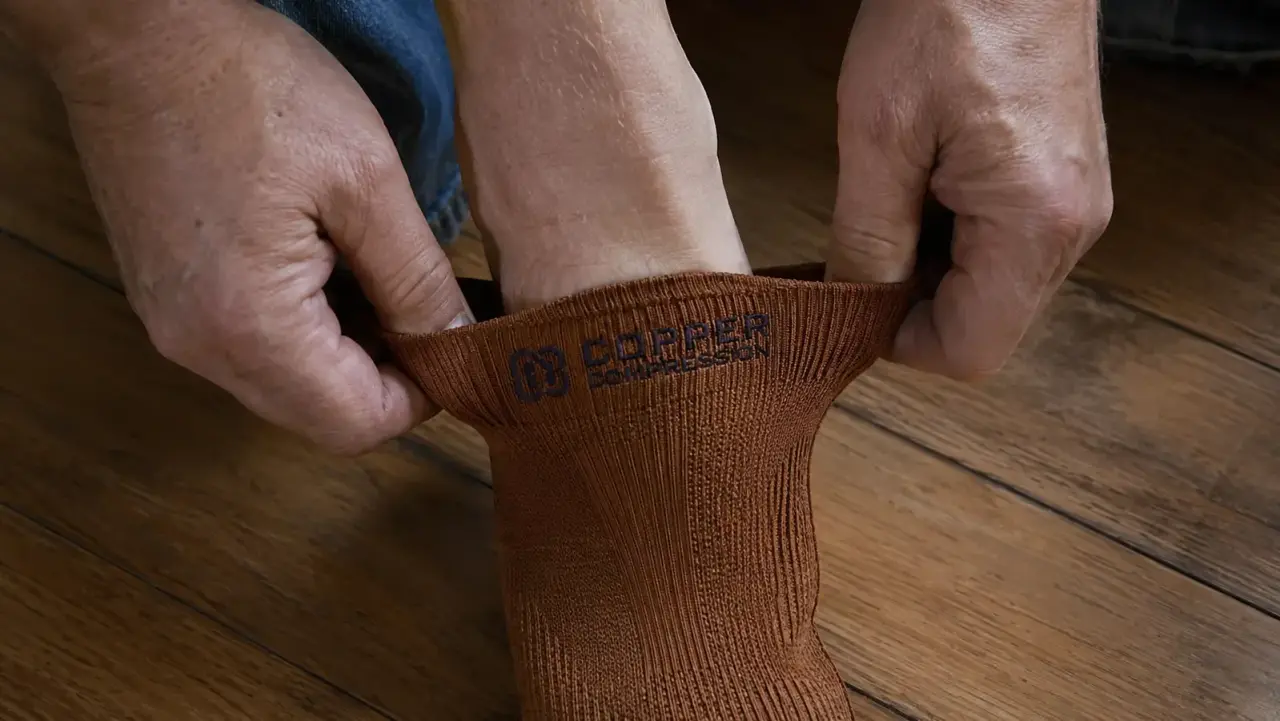
Here is the straight answer: the copper in these socks does not reduce swelling. Compression does. The copper-infused fiber is woven into the fabric to give it antimicrobial properties, which means odor control over repeated wears. That's a real and useful benefit if you're a driver who puts in a ten-hour shift and doesn't always have time to wash socks that night. But the copper does not improve circulation, does not help with varicose veins, and does not reduce ankle swelling. Graduated compression at 15-20 mmHg does those things. To be clear about what I am reviewing here, this is the Copper Compression 6-pair set, the one that shows up at the top of the search results.
Why does this matter? Because if you buy these expecting the copper to do the work, you're going to be disappointed, and you're going to blame the sock for something the sock never claimed to fix in the fine print. The compression is the mechanism. The copper is the odor bonus. Once you understand that separation, you can evaluate these correctly: as a solid graduated compression sock that also happens to resist odor better than plain merino or cotton alternatives. That's a useful combination for a working body. It's just not the magic copper cure the branding implies.
The copper controls odor. The compression controls swelling. Once you know which one does what, you can judge honestly whether these are worth it for your legs.
The Snug Tug: Getting Them On When You Have Thick Calves
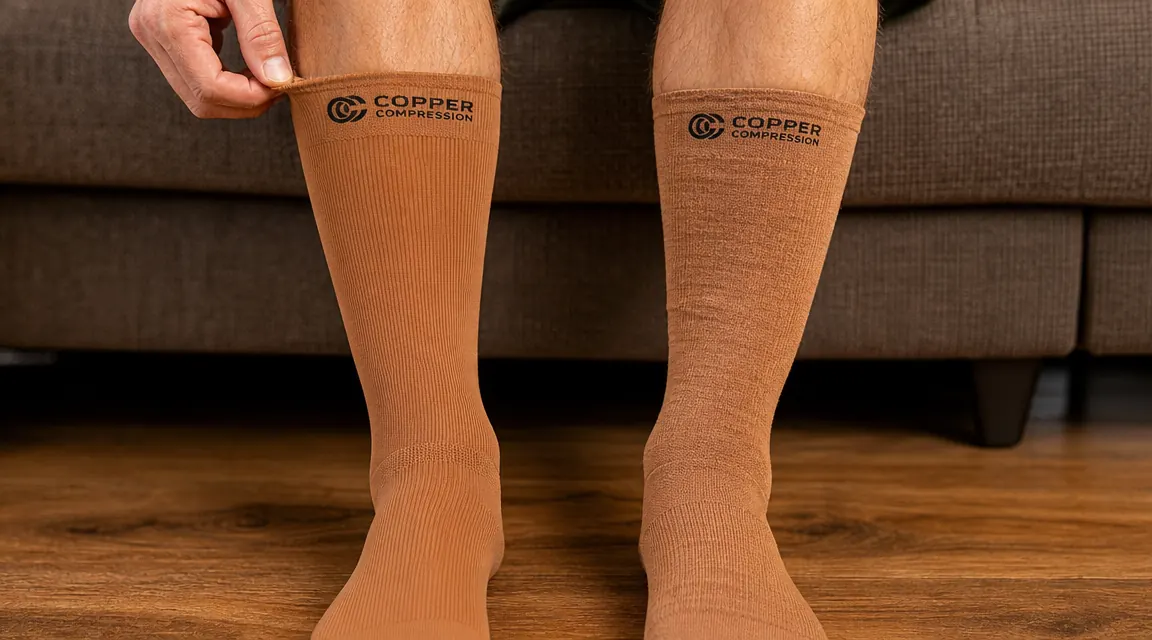
Nobody on the product page mentions this, but if you have calves above 15 inches, getting these on is a two-handed, seated, morning task. You cannot slide these up your leg standing on one foot half-awake at 4:30 a.m. You pull the cuff wide, bunch the sock down to the heel, seat the heel firmly, and then work the fabric up your leg in short upward tugs. The first few mornings, your fingers hurt. Seriously. If you give up during morning number two because it felt like a wrestling match, you've quit before the sock ever got a fair test.
There is a simple tool called a sock aid or a stocking donner that makes this roughly 30 seconds of effort instead of two frustrated minutes. If your calves are over 15.5 inches, just get one. They run about eight dollars and your mornings will be better. Do not let the putting-on struggle turn you off these socks before you've experienced what they do by hour six of a long haul. The compression is tight because it has to be tight to work. A compression sock that slides on easily at 15-20 mmHg is not actually delivering 15-20 mmHg.
On sizing: if you are between sizes, go up. The toe box runs a little short for longer feet. I wear a size 11 shoe and the Large/X-Large fits correctly lengthwise. The Medium/Large size chart lists a range up to size 12 shoe, but at 16.5-inch calves the cuff left a red mark after four hours of wear. One size up removed the problem. If you are at the high end of any size range, buy up, not in.
Does the Compression Actually Reduce Swelling for Seated Workers
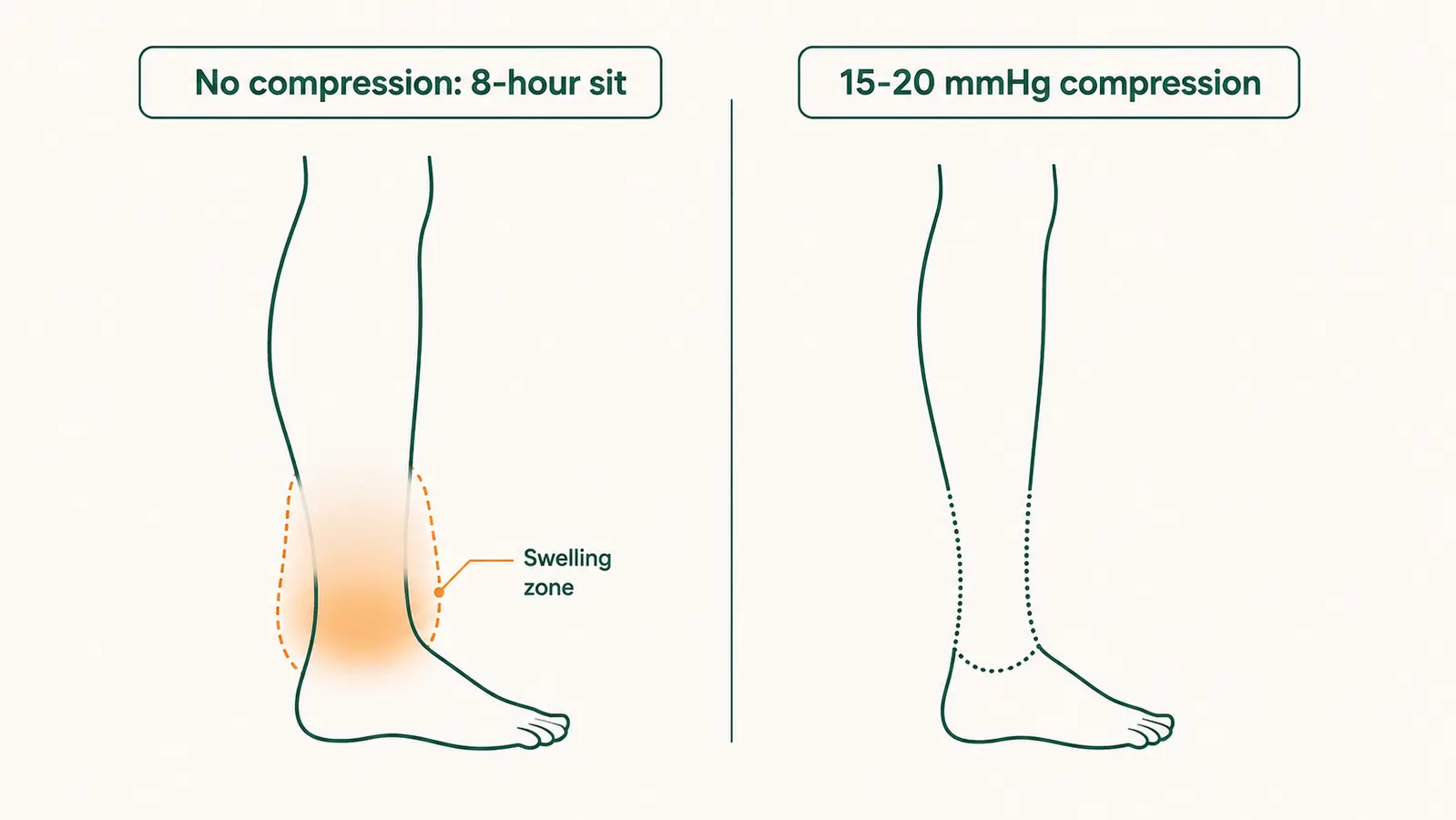
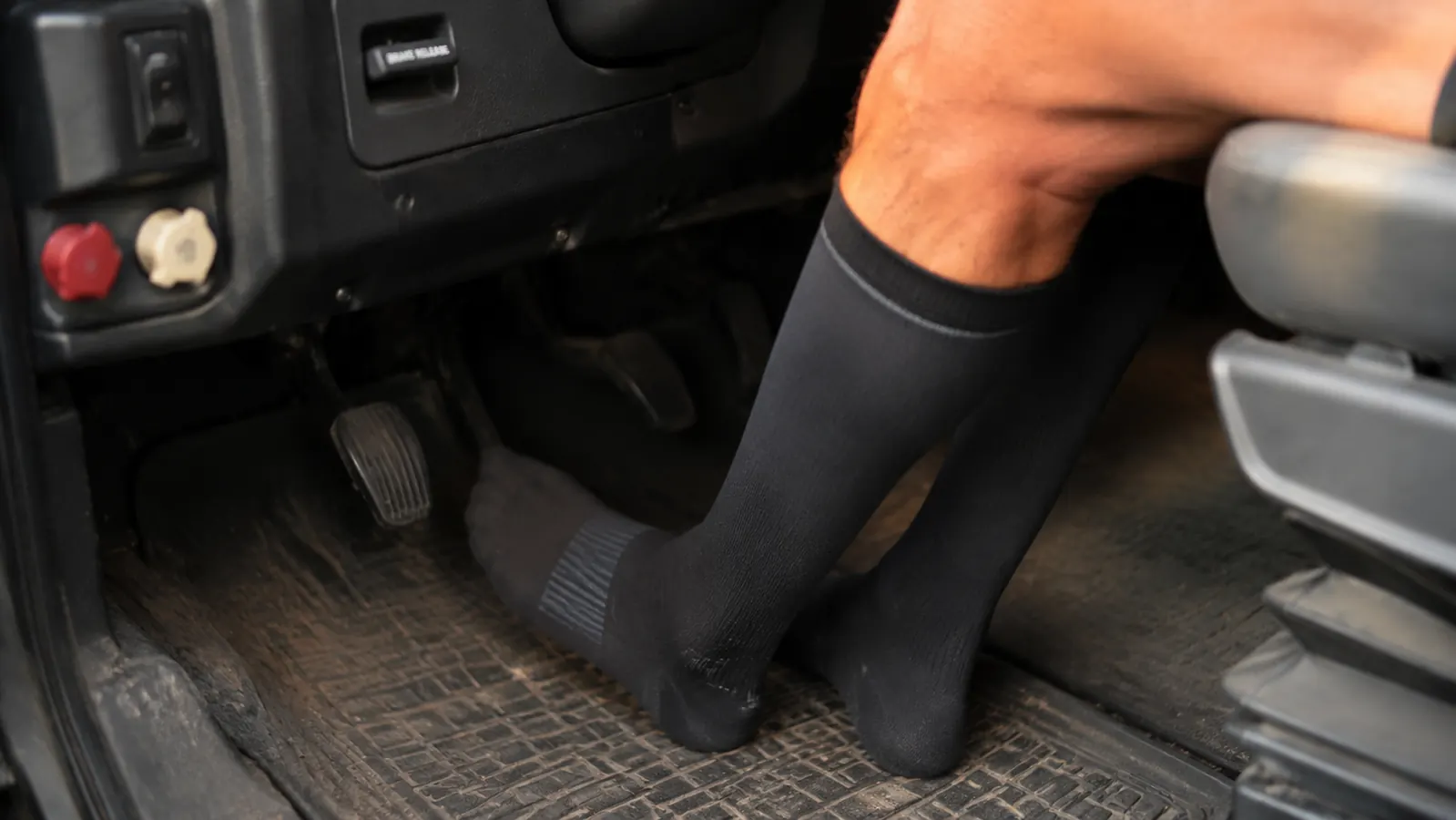
Yes, and more consistently than I expected going in. On my bare-legs control days, my right ankle always worse than my left measured about a half-inch larger in circumference at end of shift compared to morning baseline. On days with the Copper Compression socks on from the time I got in the cab, the end-of-shift difference was less than a quarter inch. Not zero, but nearly half the swelling. That is a real, measurable result across three weeks of tracking. Not miracle territory, but honest and repeatable.
The mechanism is simple and worth understanding once. When you're seated for hours, blood pools in the lower legs because the calf muscles are not moving and therefore not acting as the pumps they normally are during walking. Graduated compression squeezes harder at the ankle and progressively lighter up the calf, which mechanically assists that pooled fluid back toward the heart. The key timing detail: put them on in the morning before the pooling starts, not at the end of the day when you are already swollen. Trying to compress fluid that has already pooled for eight hours is like trying to bail a flooded boat with a coffee cup. Start with them on and the whole shift is different.
The fabric manages temperature better than I expected given how thick the knit is. On warm cab days my feet stayed dry. There is a noticeable nylon-polyester texture that is nothing like a cotton sock, but the moisture-wicking is legitimate and I did not end a shift with soaked feet the way I have with cheaper compression options.
How They Hold Up After 30-Plus Washes
This is where I have real criticism. After 30 cold-water delicate-cycle washes, the compression in the calf and ankle panel is still doing its job. I tested the snugness of a 30-wash pair against a fresh pair right out of the bag and could not feel a meaningful difference in ankle-level pressure. That part held. The bad news is the cuff band at the top, the part that holds the sock from sliding down during the day, loosens meaningfully around wash 20. On a fresh pair the cuff stays exactly where you put it for the entire shift. By wash 30 it slides about an inch down the calf by mid-shift. Not a disaster, but enough to notice if you are used to the fresh-pair fit.
The six-pair pack actually solves this problem better than any two-pair setup could. With six pairs rotating through a weekly wash, each individual pair sees the machine far less often. If you wash twice a week and wear one pair per workday, each pair is in the wash roughly twice a month. At that frequency the cuff elasticity should hold comfortably for well over a year of daily use. Buy the six-pack as a full set and rotate them consistently. Running two pairs daily is the fastest path to saggy cuffs and a review that says these fall apart fast.
When 15-20 mmHg Is Not Enough
These are over-the-counter compression socks rated 15-20 mmHg. That's mild-to-moderate graduated compression, appropriate for general tired or swollen legs, travel, long occupational shifts, and minor circulation support for healthy adults. It is not appropriate for diagnosed chronic venous insufficiency, lymphedema, moderate-to-severe varicose veins with associated pain, or post-surgical DVT prevention. If a doctor has told you that you need 20-30 mmHg or 30-40 mmHg compression, these are not the right product for that job. Those pressure levels require a prescription, a fitting with a qualified medical provider, and a specific graduated compression garment.
If your legs are swollen by midday, visibly red around the ankle, or you feel a burning or heaviness that does not resolve after a night's sleep with your feet elevated, see a doctor before you treat it with compression socks. I'm not being overly careful for legal reasons. I know guys who wore compression socks for two years on worsening leg swelling that turned out to be a venous issue requiring real treatment. The socks provided temporary symptom relief but masked something that was progressing. For the everyday driver fatigue and end-of-shift puffiness that most of us are dealing with, 15-20 mmHg is the correct choice. For anything that looks or feels like it's getting worse over months, get it checked by someone who can actually diagnose it.
What I Liked
- Genuine graduated 15-20 mmHg compression that measurably reduces shift swelling
- Copper infusion delivers real odor resistance across multiple wears between washes
- Six-pair pack makes daily rotation practical without running out or constant laundering
- Works for both men and women with gender-neutral sizing across a wide range
- Moisture-wicking knit keeps feet dry even in a warm cab through a long shift
- Nearly 48,000 reviews with a 4.5-star average is not a sample-size fluke
Where It Falls Short
- Getting them on requires real effort, especially if your calves are over 15 inches
- Cuff band elasticity noticeably loosens after 25 to 30 wash cycles
- Size chart runs small at the top of each range: when in doubt, size up
- 15-20 mmHg is not a medical-grade solution for diagnosed venous conditions
- Toe box runs short for longer feet in the smaller size ranges
Who This Is For
If you drive for a living, sit behind a desk for eight or more hours a day, work a nursing floor, run a warehouse route, or hold any job where your legs are locked in a seated position or standing on hard floors for most of the shift, this product is built for you. The six-pair price makes the daily-rotation habit easy to stick to. The 15-20 mmHg compression level is exactly right for occupational swelling and accumulated shift fatigue. The copper odor control is a real and practical daily bonus, not a gimmick for someone who needs to rewear socks on a two-day run. If your primary issue is heavy, tired, visibly swollen legs at the end of a shift and you have never tried graduated compression, start here. Most people who stay consistent notice the difference within the first week. If you want the full long-term picture before you commit, read our companion piece on what consistent daily wear looks like across months of nursing shifts.
Who Should Skip It
If you have calves over 17 inches, the standard size chart may not accommodate you comfortably even at the largest option. Check the brand's XL sizing carefully before buying. If you have a diagnosed circulatory condition requiring 20-30 mmHg or higher, go to a medical supplier and get fitted by a professional rather than buying off Amazon. If you're looking for a thin liner sock that disappears invisibly inside a dress shoe, these are not that. The knit is noticeable, the cuff has visible texture, and you will see them under slim-cut dress pants. They work correctly under work boots, heavy-duty socks, and athletic shoes. They are not invisible dress-sock territory, and they should not be sold as such.
Six pairs so you never have to rewear a damp sock at 4:30 a.m.
The compression that actually cuts shift swelling is already on nearly 48,000 drivers, nurses, and workers. Check today's price and the sizing chart before your next run.
Amazon Check Today's Price on Amazon →